Links

Telekom BCx and TASSTA: Secure, Mission-Critical Communication Without Compromise

Raising the Standard for Critical Communications

In situations where every second counts—emergency services, lone worker operations, and large-scale crisis response—communication is more than a necessity; it is a lifeline. To meet these high-stakes demands, TASSTA joined forces with Telekom Business Critical X (BCx) to deliver a next-generation solution for secure, reliable, and future-ready communication across Germany.

The Challenge: Instant, Secure Communication Under Extreme Conditions

First responders and field personnel often face unpredictable environments—industrial sites, disaster zones, or large public events—where conventional networks and tools are not enough. The requirements were clear:
  • Real-time voice and video communication for immediate situational awareness
  • Guaranteed reliability even in critical or high-risk operations
  • End-to-end security to protect sensitive data and ensure GDPR compliance
  • Easy integration with existing infrastructure without costly network upgrades
Telekom sought a solution that combined the flexibility of modern broadband networks with the robustness of mission-critical radio systems—while maintaining the highest standards of security and performance.

The Solution: TASSTA’s Mission-Critical Platform on Telekom BCx

Together, TASSTA and Telekom BCx designed a comprehensive communication platform that redefines how teams stay connected in emergencies:
TASSTA’s Capabilities Integrated with BCx
  • Push-to-Talk & Push-to-Video: Real-time voice and live video streaming for instant decision-making
  • Unicast, Multicast & Broadcast: From targeted messages to wide-area alerts
  • Live Location Tracking: Precise GPS monitoring for rapid coordination
  • Lone Worker Protection: Automated alarms in case of falls or other critical incidents
  • End-to-End Encryption: Secure, GDPR-compliant communications with auto-delete mechanisms
Seamless Integration and Flexibility
  • Operates across mobile networks, Wi-Fi, and private campus networks without the need for additional infrastructure
  • Functions on multi-purpose devices, combining the power of a smartphone, two-way radio, and personal safety alarm

Results: A New Era of Mission-Critical Communication

By leveraging Telekom’s nationwide 5G and renewable-energy-powered network, the combined TASSTA–BCx solution delivers:
  • Uncompromising Reliability: Stable, real-time communication even in extreme conditions
  • Rapid Emergency Response: Centralized control room capabilities for instant alerting and deployment
  • Future-Proof Scalability: A modern alternative to traditional TETRA systems with flexible growth potential
  • Sustainability: Supported by a network powered 100% by renewable energy

Looking Ahead

By combining TASSTA’s advanced software platform with Deutsche Telekom’s secure, nationwide connectivity, Telekom BCx sets a new benchmark for mission-critical communication in Germany and beyond. From emergency responders to industrial safety teams, the message is clear: 
When it matters most, you can’t afford delays—and with BCx, you won’t have them.
Continue reading

TASSTA Announces the Official Launch of TASSTA France

TASSTA Announces the Official Launch of TASSTA France

Paris, France, 09/09/2026

TASSTA today announced the official launch of TASSTA France, extending its presence into the French market.

TASSTA France will operate from a new office in Paris and serve as the company’s direct point of contact for public safety agencies, transport operators, utilities and enterprise organizations across the country. Beyond push-to-talk, TASSTA’s platform brings communication, coordination and operational tools, including push-to-video, messaging and data, GPS and mapping, lone worker protection, guard tour and patrol management, and drone and CCTV integration, into one secure environment for control rooms and field teams.

Leading TASSTA France is Dounia Daoud, who brings more than 15 years of experience in the technology and telecommunications sectors. In her role, Dounia is responsible for TASSTA’s business development activities in France, building relationships with customers and partners and supporting organizations through the adoption of mission-critical communication technology.

The TASSTA team will also be present in France at two upcoming industry events: the RCPA Annual Conference in Paris on October 15, 2026, and the AGURRE 2026 Conference, also in Paris, on November 19, 2026. Learn more in our Event Section: tassta.com/events

About Dounia Daoud

Dounia Daoud leads TASSTA’s business development activities in France and serves as the company’s primary point of contact for the French market. With more than 15 years of experience in the technology and telecommunications sectors, including roles at Ericsson, IBM and SIAE Microelettronica, she brings extensive expertise in strategic account development, partner ecosystems and complex B2B sales. At TASSTA, she is focused on strengthening the company’s presence in France, developing new customer and partner relationships, and supporting organizations in the adoption of secure and mission-critical communication solutions.

Contact
Dounia Daoud
TASSTA France
61 rue de Lyon, 75012 Paris
dounia.daoud@tassta.fr
+33 6 22 99 68 26
tassta.fr

Continue reading

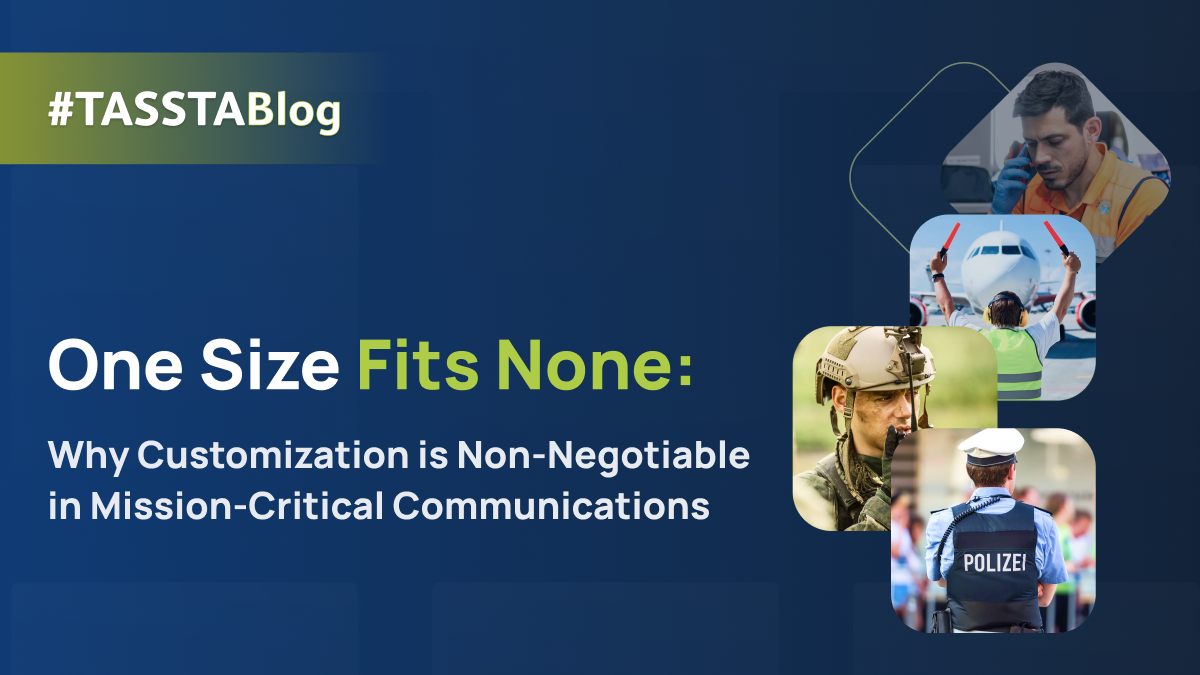
One Size Fits None: Why Customization Is Non-Negotiable in Mission-Critical Communications

One Size Fits None: Why Customization Is Non-Negotiable in Mission-Critical Communications

Most vendors selling mission-critical communications will tell you their platform is flexible. Most of them are stretching the truth.

What they usually mean is that you can change the logo, pick a color scheme, and choose from a menu of pre-built modules someone else decided you might need. That is not customization. It is the appearance of choice layered over a product that was never built with your specific operation in mind.

The distinction matters more in this sector than almost anywhere else, because the cost of getting it wrong is not a bad user review. It is a dispatcher who cannot find the emergency button under stress, a field officer buried in eleven settings they don’t need when they need the twelfth, a control room that discovers, mid-incident, that the new platform was never actually built to talk to the TETRA network running the rest of the operation. None of these are edge cases. They are what happens, predictably, when a generic platform is sold into an environment that was never generic to begin with.

What Customization Actually Means

Customization in this context is not about logos and color schemes. It is operational fit at every layer, because no two organizations, even within the same industry, run the same way.

Interface design by role. Different users within the same organization interact with communications systems in fundamentally different ways. Drivers, supervisors, and control room operators all need different information visible, different actions one tap away, and different levels of access to configuration. A role-specific interface reduces cognitive load precisely when cognitive load is highest: during an incident.

Locked profiles for consistency. For safety-critical teams, the ability to customize is not always the goal. The goal is consistency: every user on every device seeing the same interface, with no risk of accidental reconfiguration. Administrators set it once, users get a locked, predictable tool. That reliability is itself a form of customization: deliberate, controlled standardization for teams that cannot afford variation.

Legacy system integration. Most organizations do not start with a blank infrastructure slate. They have TETRA networks, GNSS tracking systems, third-party dispatch platforms, and years of operational logic built into existing tools. A platform that cannot integrate with what is already there does not simplify the environment. It complicates it. Real customization means meeting the customer’s infrastructure where it is.

Workflow-native features. The most effective deployments go further: building features that match specific operational processes from the ground up. When those features are developed in close collaboration with the customer, they reflect genuine operational knowledge, not assumptions made in a product roadmap meeting.

Affordability and speed of delivery. Custom feature development only delivers value if it is accessible and arrives within a timeframe the operation can act on. In mission-critical industries, a capability that takes years to procure or arrives at a cost that excludes all but the largest organizations is not a solution, it is a barrier. The economics and the delivery timeline are part of the fit. A platform that can respond quickly and within budget to a specific operational requirement is genuinely more capable for this sector, regardless of how its feature list compares on paper. It is also worth noting that customization does not always mean complexity. Many of the most impactful fixes are straightforward: a reorganized interface, a renamed button, a single additional field in a dispatch screen. The solution to a real operational problem is sometimes a small one. What matters is that someone was willing to make it.

The Adoption Argument

There is a practical dimension here that often gets overlooked in procurement discussions: user adoption.

A mission-critical communications platform is only as good as the behavior it produces under pressure. If the interface is unfamiliar, cluttered, or misaligned with how a team actually operates, users will work around it, defaulting to radios, personal phones, or verbal chains of communication that bypass the system entirely. That is not a user problem. It is a design problem.

Systems that integrate seamlessly with existing workflows get used correctly. Systems that require users to adapt to the tool, rather than the tool adapting to the user, introduce friction that erodes reliability over time.

Start with the Problem, Not the Platform

Not every organization needs the same depth of customization. A small operation with straightforward workflows may be well served by a standard configuration. That is a legitimate starting point.

But even then, the right question is not “which platform fits our budget?” It is “which platform actually fits us?” Those are different questions, and they lead to very different outcomes.

The organizations that get mission-critical communications right tend to share one thing in common: they worked with a vendor who listened before they built. Who asked what the real operational problems were. Who understood the existing infrastructure, the team structure, the failure modes, and the edge cases, and then shaped the platform around those realities rather than asking the organization to reshape itself around the platform.

That is what good customization looks like in practice. Not a checklist of features. Not a product roadmap pushed onto a customer. A communication platform that fits the way a specific organization actually operates, because it was designed with that organization, not just for a market segment it belongs to.

The platform should conform to the organization. Not the other way around.

Continue reading

TASSTA and Datamatik at ONS 2026

TASSTA and Datamatik at ONS 2026

TASSTA, together with Datamatik, will participate in ONS 2026 as part of the MTN Norway AS stand in Stavanger from 24 to 27 August.

Visit the MTN Norway AS stand to experience live demonstrations of TASSTA’s mission-critical communication solutions for the energy sector, including:

– TASSTA MCX Push-to-Talk (MCPTT) for instant and reliable voice communication
– Push-to-Video (MCVideo) for real-time visual information and improved situational awareness
– Indoor localization, Guard Tour and Lone Worker Protection for iPhone and Android, supporting precise positioning, digital patrol management and personnel safety
– Integration with TETRA, DMR, analog and other radio networks through TASSTA Bridge, connecting existing radio infrastructure with broadband communications.

From offshore operations and maintenance teams to emergency response and critical infrastructure, TASSTA helps keep personnel connected, informed and safe in demanding working environments.

ONS 2026, Stavanger
24 to 27 August
TASSTA and Datamatik, as part of the MTN Norway AS stand

Continue reading

TASSTA MCX Joins the Communications Backbone of the Dubai Metro Blue Line

TASSTA MCX Joins the Communications Backbone of the Dubai Metro Blue Line

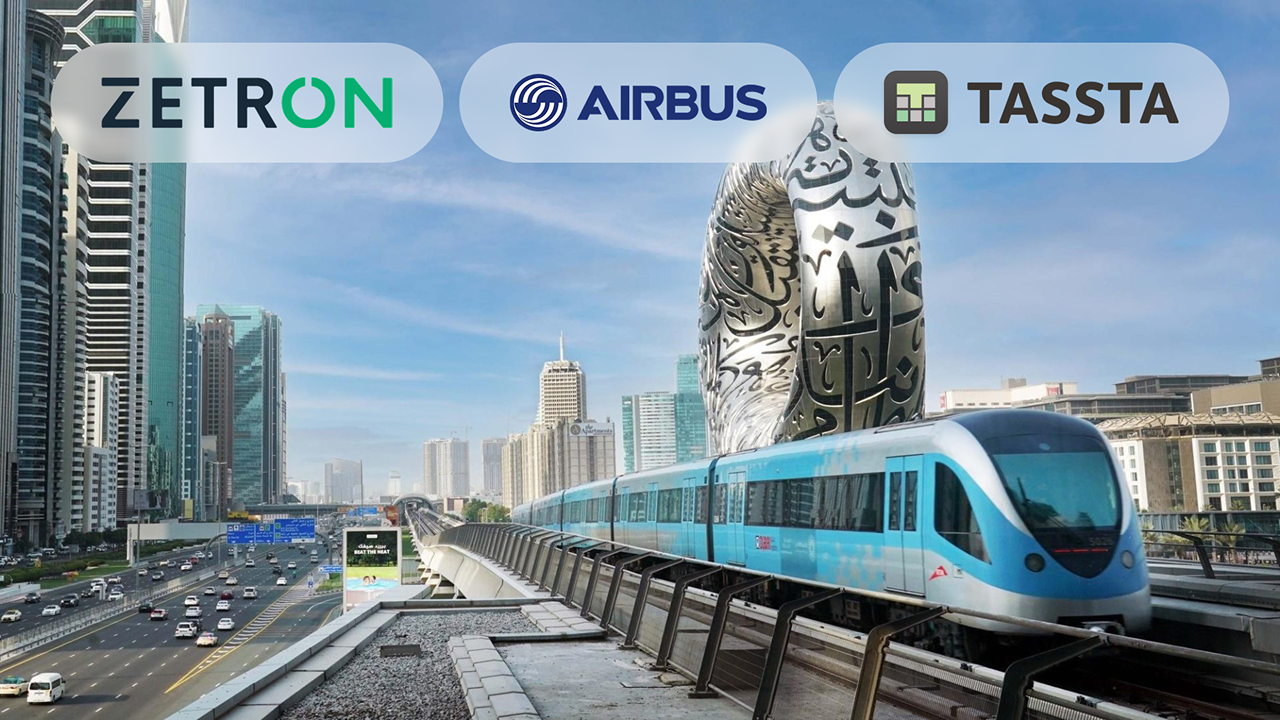
Esharah, a subsidiary of Nedaa (Professional Communication Corporation), has selected Zetron’s ACOM Unified Communications System to support operations on the Dubai Metro Blue Line, one of the region’s most significant transportation projects. The Blue Line will run 30 kilometres across 14 stations, connecting districts including Dubai Creek Harbour, Dubai Silicon Oasis, and Dubai International City, with interchanges to the existing Red and Green Lines and to the Etihad Rail network.
ACOM will bring together Airbus TETRA, TASSTA MCX, and telephony services into a single operational environment for the project. Operators across primary and backup control centres, as well as remote locations, will manage communications through one unified platform, built to deliver the geo-redundancy and interoperability a metro network serving millions of passengers requires.
The selection was announced by Zetron at Critical Communications World 2026 in London. For TASSTA, the project is a further step in the company’s ongoing collaboration with Esharah and Nedaa in the UAE, and confirms TASSTA MCX’s role alongside TETRA and telephony in large-scale, multi-technology transport communications deployments.

Continue reading

TASSTA Confirms MCX Interoperability at the 10th ETSI MCX Plugtests in Sophia Antipolis

TASSTA Confirms MCX Interoperability at the 10th ETSI MCX Plugtests in Sophia Antipolis

TASSTA took part in the 10th MCX Plugtests, hosted by ETSI at its headquarters in Sophia Antipolis, France, from 18 to 22 May 2026. The event brought together more than 240 participants, including MCX application server and client vendors, network operators, and public safety stakeholders, to test the interoperability of Mission Critical Push-to-Talk (MCPTT), Mission Critical Data (MCData), and Mission Critical Video (MCVideo) implementations over live 4G and 5G networks.
The 10th edition marked a milestone for the MCX Plugtests programme, which ETSI runs with the support of the Critical Communications Association (TCCA) and the International Union of Railways (UIC), and with co-funding from the European Union and the European Free Trade Association. This round focused on 3GPP Releases 18 and 19, with particular attention to cross-system communications: the Interworking Function (IWF) connecting MCX to TETRA and P25 networks, and inter-MCX scenarios that link different systems, agencies, or countries.
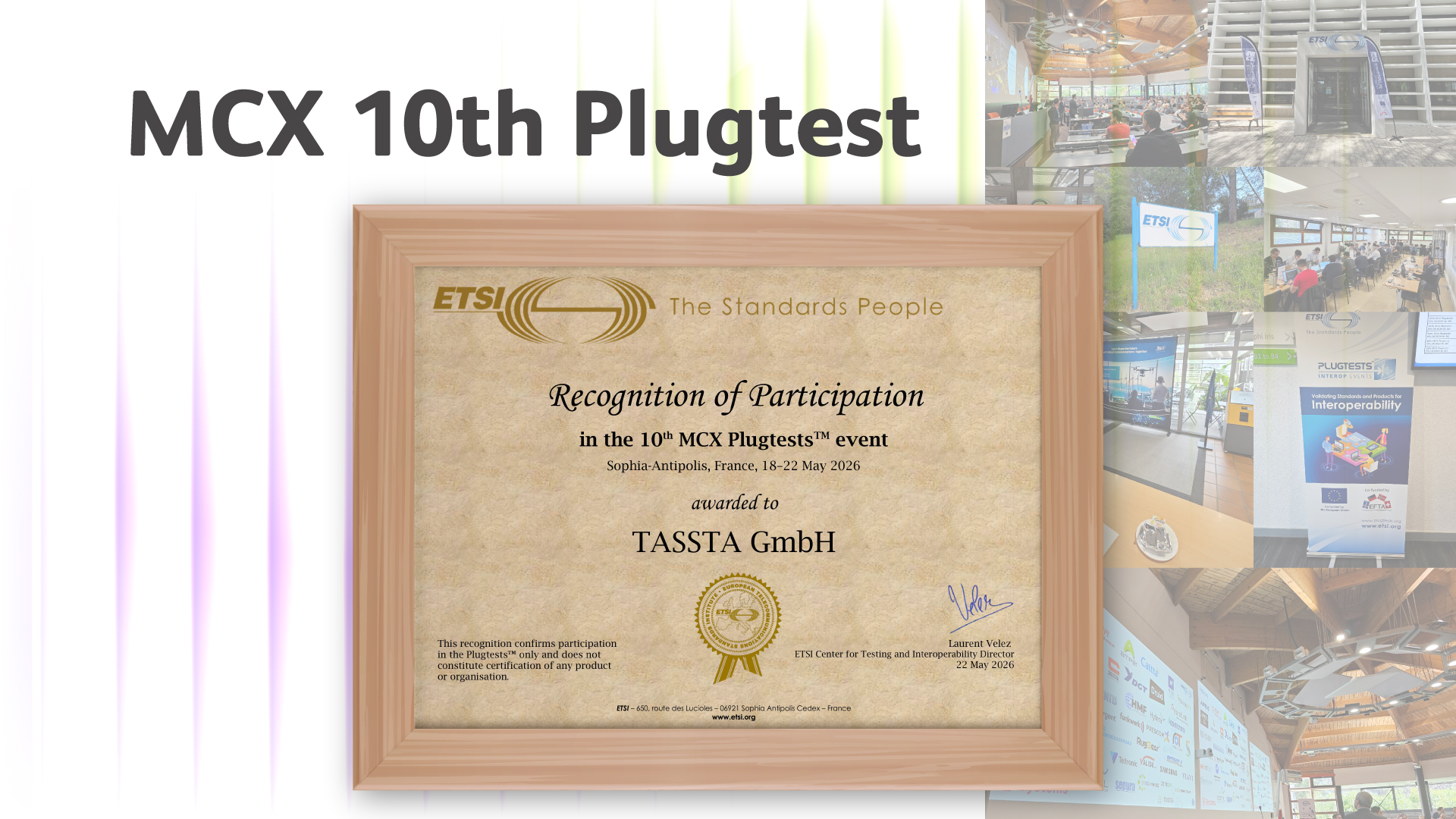
TASSTA has been part of the MCX Plugtests programme since its very first edition, making the 10th consecutive round in which the company has put its MCX solution through independent, multi-vendor testing. Following the event, TASSTA received an official Recognition of Participation from ETSI, confirming that its MCX solution was tested for interoperability against other vendors’ implementations under the programme’s live, multi-client conditions.
Participation in the MCX Plugtests programme is a recurring part of TASSTA’s product validation process. Each round tests the company’s MCPTT, MCData, and MCVideo services against the latest 3GPP specifications and against real implementations from other vendors, rather than in isolation. For customers, this provides an independent, standards-based check that TASSTA’s mission-critical communication solution works as intended alongside the wider MCX ecosystem, including devices and systems it may need to connect to in the field.

Continue reading

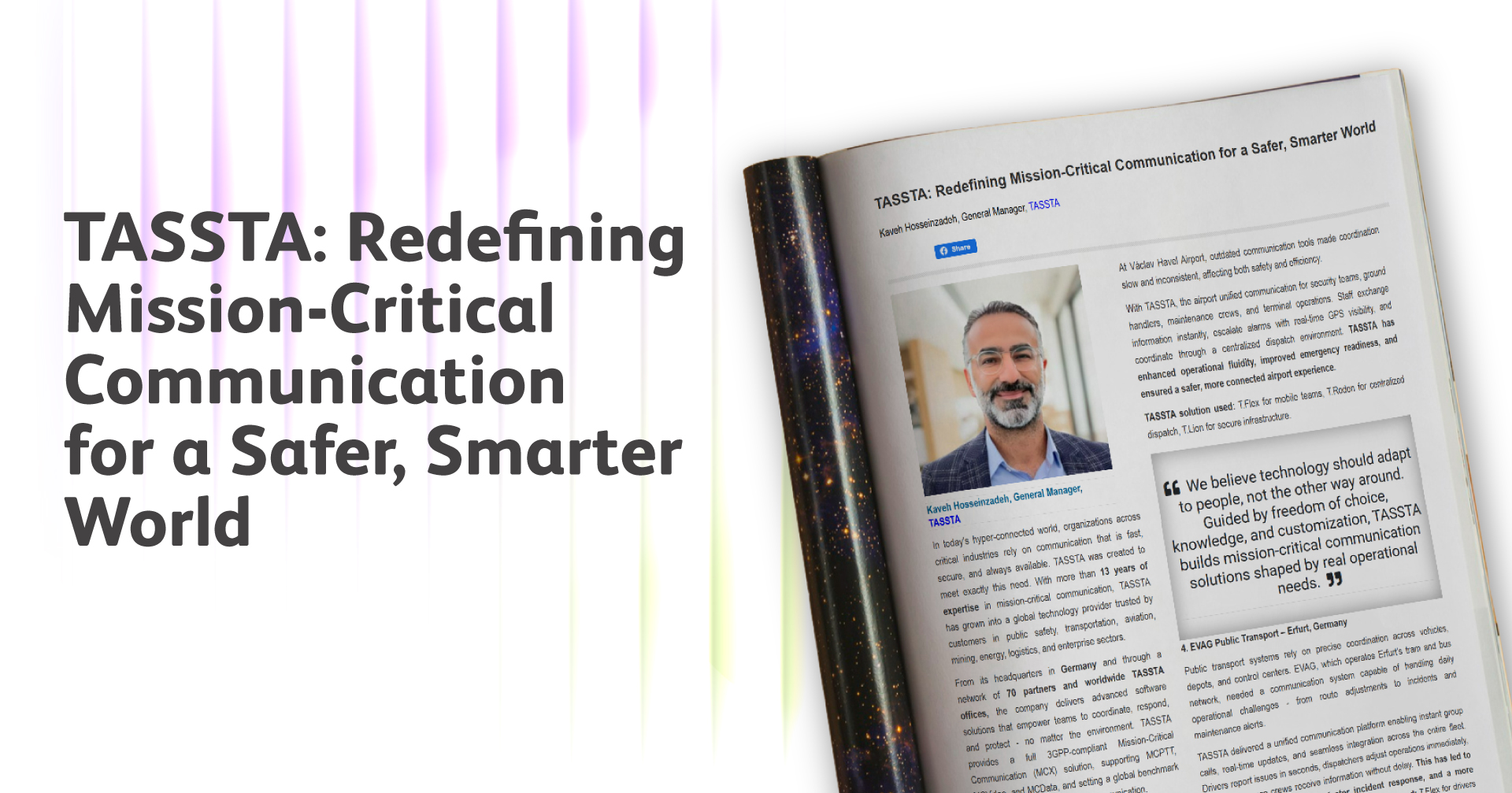
TASSTA Featured in APAC CIOOutlook for Redefining Mission-Critical Communication

TASSTA Featured in APAC CIOOutlook for Redefining Mission-Critical Communication

Hannover, Germany — 30.01.2026 — TASSTA, a global provider of mission-critical communication software, announces the publication of its featured article in APAC CIOOutlook, titled “Redefining Mission-Critical Communication for a Safer, Smarter World.” The article highlights TASSTA’s vision, technology, and real-world impact in enabling secure, reliable, and future-ready communications for mission-critical operations worldwide.

The feature explores how TASSTA addresses today’s communication challenges by delivering a software-defined platform that combines push-to-talk (PTT), real-time voice and video, location tracking, emergency management, and task coordination in a single, unified solution. Designed for environments where reliability is non-negotiable, TASSTA supports organizations operating in public safety, critical infrastructure, transportation, industry, and enterprise sectors.

The article highlights TASSTA’s seamless integration of traditional radio systems with advanced digital capabilities, supported by continuous development that adapts to evolving operational and industry demands. This approach allows organizations to modernize their communications while preserving existing investments and ensuring full interoperability across devices, networks, and technologies.

APAC CIOOutlook also emphasizes TASSTA’s focus on resilience, security, and flexibility. TASSTA solutions can be deployed on-premise or in hybrid environments, offering customers full control over data sovereignty and system availability. Built to support broadband networks, private LTE/5G, and radio interoperability, TASSTA enables a smooth transition toward next-generation mission-critical communications.

By prioritizing customization, freedom of choice, and knowledge sharing, TASSTA continues to help organizations enhance situational awareness, improve response times, and increase operational safety — without compromising reliability.

Interested to learn more, contact us at:
hello@tassta.com

Continue reading

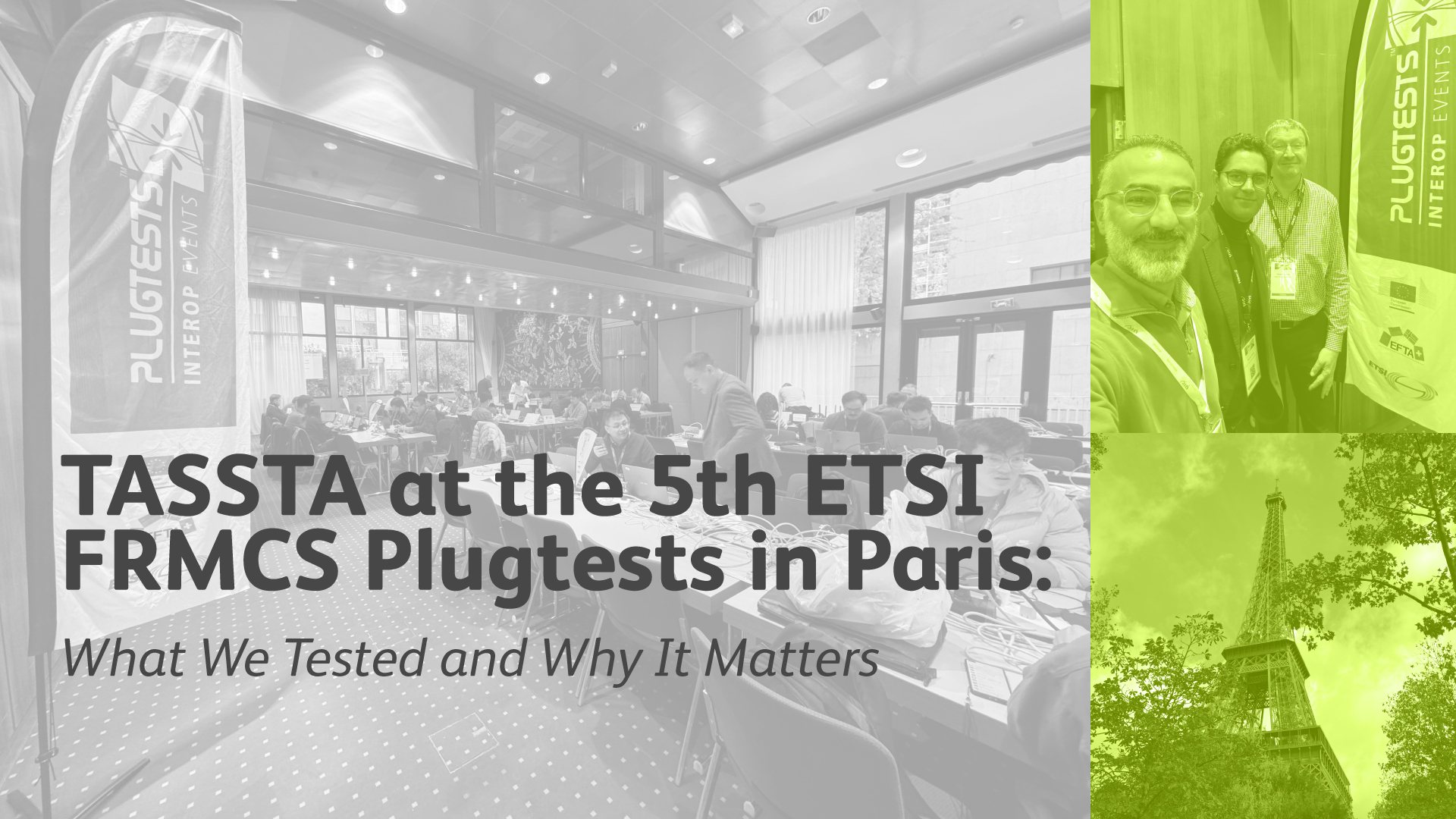
TASSTA at the 5th ETSI FRMCS Plugtests in Paris: What We Tested and Why It Matters

TASSTA at the 5th ETSI FRMCS Plugtests in Paris: What We Tested and Why It Matters

In October 2025, TASSTA participated in the 5th ETSI FRMCS Plugtests hosted by UIC in Paris. This event is part of the ETSI MCX Plugtests Programme and is designed to validate real interoperability between mission-critical (MCX) solutions and multi-vendor 5G/IMS core networks.

What is FRMCS and why Plugtests exist

FRMa Railway Mobile Communication System) is the railway industry’s next-generation communication system, intended to replace GSM-R with broadband, secure and interoperable services.

The Plugtests series is ETSI’s way to ensure that different vendors’ implementations actually work together in practice — not just on paper.

ETSI’s goals for the event:

– confirm interoperability between vendors
– validate understanding of 3GPP/ETSI standards
– help implementers find and resolve issues early

The 5th edition brought together a large multi-vendor lab with more than 170 participants, simulating an environment close to real railway deployments.

TASSTA’s setup in the lab

We brought:
– TASSTA T.XON MCX Application Server
– our MCX client(s)

This allowed us to integrate and test against multiple 5G cores from different vendors in a shared interoperability lab.

This is important because in live railway networks, MCX services must operate reliably across whichever 5G core an operator chooses. Demonstrating multi-vendor compatibility is therefore a key milestone for market readiness.

The test areas we executed

All test cases were taken from ETSI’s MCX Plugtests scenario specification ETSI TS 103 564.

1. MCPTT Group Calling (on-demand / ad-hoc)

What we tested
– Creating an ad-hoc MCPTT group call on demand, without security
[CONNMCPTT/ONN/GROUP/ADHOC/ONDEM/NOSEC/NFC/02]
– Releasing that ad-hoc group call
[CONNMCPTT/ONN/GROUP/ADHOC/ONDEM/NOSEC/NFC/03]

In simple terms
We verified that a user can start a spontaneous push-to-talk group — for example, “all staff in this station right now” — and later end it cleanly. The group is created dynamically by the MCX system and correctly transported through the 5G core.

2. Floor Control (who is allowed to talk, when)

MCPTT is not like a normal voice call — only one person (or a controlled set of people) speaks at a time. The mechanism that manages this is Floor Control (FC).

Basic FC
– Effect of priorities
[FC/BASIC/02]

Advanced FC
– Revoking the floor when a timer expires (T2)
[FC/ADV/01]
– Queueing requests after release
[FC/ADV/02]
– Queueing requests after revoke
[FC/ADV/03]

Awareness and special cases
– Functional Alias (FA) display during FC
[FC/FA/BASIC/01]
FA allows users to speak under a role (e.g., “Train Driver 17”) instead of a personal name.
– Multi-talker basic operation
[FC/MT/BASIC/01]
– Location sharing during FC
[FC/LOC/BASIC/01]
– Location sharing during multi-talker FC
[FC/MT/LOC/BASIC/01]

In simple terms
We validated that:
– the system correctly assigns the “right to speak”
– priority users override lower-priority requests
– the floor is revoked automatically if held too long
– queued talkers get their turn in order
– operators can immediately see who is speaking (via alias/role) and, when relevant, where they are — even in multi-talker situations

These are essential railway features, enabling dispatchers and field teams to maintain clear, disciplined voice communication in high-stress situations.

3. 5G QoS Integration (making mission-critical traffic “special” in the 5G core)

Mission-critical voice requires guaranteed quality (latency, priority, stability). In 5G, this is achieved via dedicated QoS flows.

We tested:
– Creating a unicast 5GS QoS flow via Rx
[PCC/5GSQOSFLOWSETUP/Rx/02]
– Creating a unicast 5GS QoS flow via N5
[PCC/5GSQOSFLOWSETUP/N5/02]
– Updating a unicast 5GS QoS flow via Rx
[PCC/5GSQOSFLOWUPDATE/Rx/02]

In simple terms

We checked that the TASSTA MCX server can request mission-critical treatment from the 5G core — using standard 3GPP policy control interfaces — for specific users’ media streams.
This allows the network to prioritize MCPTT traffic over normal data traffic, which is a core requirement for FRMCS deployment.

What we gained from the Plugtests

Even without sharing confidential results, the value is clear:
– Multi-vendor realism — testing our stack against diverse 5G cores and MCX implementations in one environment
– Standards confirmation — verifying our implementation aligns with ETSI/3GPP intent
– Early issue discovery — solving interoperability problems in the lab, before they appear in real railway networks

Why this matters for the railway industry

FRMCS will only succeed if:
1. vendors interoperate,
2. mission-critical QoS is correctly enforced in 5G cores,
3. railway-specific MCX behavior (roles, priorities, multi-talker logic, location) operates reliably.

This Plugtests edition showed the ecosystem moving from “specification compliance” to field-ready interoperability.


Thank you

Big thanks to ETSI Plugtests, UIC, and all participating vendors and operators for a highly collaborative environment.
TASSTA is proud to contribute to the maturity of FRMCS and MCX interoperability, and we will continue this work in upcoming ETSI/3GPP programmes.

Continue reading

NEDAA and Its Subsidiary ESHARAH & TASSTA Join Forces to Revolutionize Mission-Critical Communications in Dubai

NEDAA and Its Subsidiary ESHARAH & TASSTA Join Forces to Revolutionize Mission-Critical Communications in Dubai

Dubai, UAE — 21st November 2025
Nedaa – Professional Communication Corporation, along with its subsidiary ESHARAH ETISALAT SECURITY SOLUTION, Dubai’s exclusive provider of secure mission-critical communications, has announced an exciting strategic collaboration with TASSTA GmbH, a global leader in next-generation mission-critical communication (MCX) technology.
This partnership is set to redefine secure communications for government agencies, first responders, and public safety organizations across the emirate. By combining TASSTA’s cutting-edge MCPTT and advanced dispatching solutions with Nedaa’s state-of-the-art TETRA and LTE/5G network infrastructure, the collaboration delivers faster response times, seamless inter-agency coordination, and real-time situational awareness—critical for the fast-paced demands of Dubai’s smart-city initiatives.
“Nedaa and its subsidiary ESHARAH are committed to pushing the boundaries of secure, mission-critical communications,” said a Nedaa spokesperson. “Our collaboration with TASSTA ensures that government and public safety agencies have the tools they need to act quickly, decisively, and confidently.”
“TASSTA is proud to partner with Nedaa and its subsidiary ESHARAH to bring reliable, scalable, and interoperable solutions to Dubai,” added a TASSTA representative. “Together, we’re enabling a communication ecosystem that’s ready for today—and tomorrow.”
The joint solution includes secure MCPTT deployment, cross-platform interoperability, advanced dispatching, and enhanced incident management tools—delivering critical information when it matters most, every time. This partnership cements Dubai’s position as a leader in technological innovation, operational readiness, and smart-city excellence.

Continue reading

TASSTA to Showcase MCX Solutions at PMRExpo 2025

TASSTA to Showcase MCX Solutions at PMRExpo 2025

TASSTA is heading to PMRExpo 2025, Europe’s leading trade fair for secure communication, taking place in Cologne from November 25–27, 2025. Visitors can find the TASSTA team at Hall 7, Stand E48.

PMRExpo serves as the central meeting point for professionals shaping the future of mission- and business-critical communication. Each year, the event brings together experts, providers, and users from across industries – from public safety and critical infrastructure to transport and utilities.

TASSTA will be on site to showcase its latest developments in mission-critical Push-to-Talk, Push-to-Video, and Push-to-Data solutions, all designed to ensure reliable, secure, and efficient communication across teams and networks.

Meet the TASSTA Team in Cologne
Visitors are invited to stop by Stand E48 to meet the TASSTA team, discover new features, and discuss how TASSTA’s solutions are transforming secure communications around the world.

See you at PMRExpo 2025 in Cologne!

How it was in 2024

  • Image (1)_result_860

  • Image (2)_result_860

  • Image (3)_result_860

  • Image (4)_result_860

  • Image (5)_result_860

  • Image (6)_result_860

  • Image (7)_result_860

  • Image (8)_result_860

  • Image (9)_result_860

  • Image (10)_result_860

  • Image (11)_result_860

  • Image (13)_result_860

  • Image (12)_result_860

  • Image (14)_result_860

  • shared image (1)_result_860

  • shared image (2)_result_860

Continue reading

Educational resources

Stay ahead with insightful resources.
Explore our latest blogs, case studies, and whitepapers that delve into the intricacies of mission-critical communication, technological advancements, and industry trends.

Explore more about TASSTA

Social media
     
Media partnership
marketing@tassta.com
Headquarters
GMC TASSTA GmbH
Hannover
Bödekerstr. 56 
30161 Hannover
Germany
Berlin
Kurfürstendamm 14
10719 Berlin
Germany

Privacy Overview

This website uses cookies so that we can provide you with the best user experience possible. Cookie information is stored in your browser and performs functions such as recognising you when you return to our website and helping our team to understand which sections of the website you find most interesting and useful.