A football match depends on coordination long before the players step onto the pitch. Operational and technical teams manage preparations, match-day logistics and daily activities, keeping information moving between the people involved.
At Leones Fútbol Club, TASSTA’s Push-to-Talk platform, integrated with RugGear RG360 devices, supports this work through real-time voice communication over cellular networks. The solution keeps teams connected even when they are working in different cities.
The Challenge: Coordinating Teams Across Locations
Leones FC’s communication needs extend beyond the stadium. Its operational and technical teams need to exchange updates and coordinate activities both locally and across cities.
The club needed a practical way to support:
Communication between operational and technical staff.
Coordination of match-day logistics.
Information sharing between teams in different cities.
Communication during everyday club activities.
The Solution: TASSTA Push-to-Talk on RugGear RG360 Devices
Leones FC uses RugGear RG360 devices integrated with TASSTA’s professional Push-to-Talk platform.
RugGear provides the devices, while TASSTA provides the software that connects users over cellular networks. Staff can communicate at the press of a button, supporting coordination wherever mobile connectivity is available.
The combination brings professional communication into the club’s daily workflow, connecting the people responsible for logistics and technical operations.
TASSTA and RugGear enable Leones FC’s operational and technical teams to communicate in real time, including between different cities.
The Results: Connected Teams, from Daily Operations to Match Day
Match-day logistics: Keeping operational staff connected as they coordinate activities.
Technical operations: Enabling teams to exchange updates during preparations and ongoing work.
Day-to-day coordination: Maintaining communication beyond match days and across locations.
A Partnership Supporting Football Operations
Looking Ahead
The Leones FC deployment shows how professional Push-to-Talk communication can support the work behind a football club.
By combining TASSTA’s communication platform with RugGear devices, Leones FC connects its operational and technical teams across the locations where they work.
TASSTA is proud to support Leones FC alongside RugGear. We thank both teams for their trust.
World-Class Safety for the Tour de Suisse: How Swisscom Broadcast and TASSTA Transformed Race Security
Raising the Bar for Cycling Safety
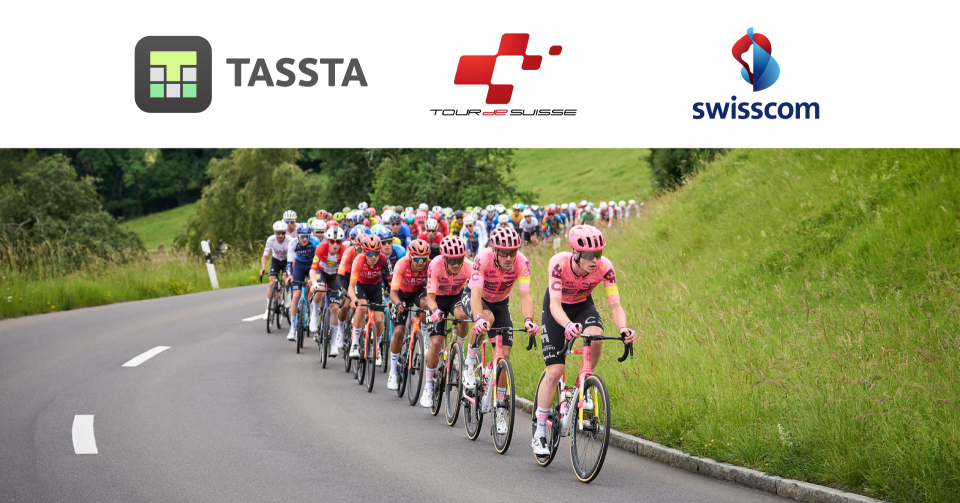
In 2025, the Tour de Suisse (TdS) took a groundbreaking step toward improving rider safety. Following the tragic accidents in international cycling events in Switzerland the previous year, the race’s organizing committee, led by Director Olivier Senn, set out to implement the most advanced safety measures in the event’s history.
At the heart of this transformation was a mobile safety command center built by Swisscom Broadcast, powered by TASSTA’s Push-to-Talk over Mobile (PTToM) technology. This was not just an upgrade—it was a world first for cycling safety, bringing together voice, video, GPS tracking, and real-time data into a single, fully connected system.
The Challenge: Coordinating Safety Across an Entire Country
The Tour de Suisse spans hundreds of kilometers of challenging terrain over eleven race days, with riders, team vehicles, security escorts, and support crews constantly on the move. The safety challenge was clear:
Keep every stakeholder connected at all times, even in remote or high-traffic network areas
Integrate multiple systems—from GPS tracking to live video feeds—into a single operational hub
Deliver instant, reliable, and secure communication between race control, course marshals, team cars, and the motorized safety convoy
The Solution: TASSTA at the Core of a Mobile Safety Command Center
Swisscom Broadcast, already trusted from its flawless PTToM service in the previous year’s race, partnered again with TASSTA to deliver a fully mobile, fully integrated safety solution.
Key features of the deployment included:
Mobile Safety Command Center housed in a Swisscom mobile shop trailer, with three fully accessible operator workstations
Dispatcher console for multi-channel radio and PTToM communications
GPS tracking for every rider via small, discreet trackers that trigger alerts for sudden stops or rapid deceleration
Live mapping of all race convoy vehicles directly on the command center screens
Integration with seven live TV feeds, weather radar, and pre-mapped hazard points from VeloViewer
Multi-channel capability in race control and safety vehicles with special kits enabling up to four simultaneous communication channels
400 connected devices for various roles, including motorcycle intercom systems
TASSTA’s PTToM solution delivered:
Nationwide group communications independent of local infrastructure
Priority handling, ensuring messages get through even in congested mobile networks
Seamless integration between radio and broadband devices
Encrypted, secure voice and data exchange across all participating teams
The Results: Real-Time Awareness, Immediate Response
During the 2025 Tour de Suisse, the mobile safety command center was tested to its limits—and passed with flying colors.
Comprehensive situational awareness: Race officials could see the location of every rider, vehicle, and potential hazard in real time.
Faster incident response: GPS alerts and live video allowed the safety team to intervene within seconds.
Seamless coordination: Instant PTToM communication linked the command center, course marshals, team cars, and security escorts, regardless of location.
Olivier Senn, Director of the Tour de Suisse, praised the solution:
“Swisscom Broadcast earned my trust last year with their flawless communication solution. They understood our needs for a safety command center and delivered perfectly.”
Looking Ahead
The success of this deployment marks a new standard for cycling event safety. By merging TASSTA’s mission-critical broadband communication with Swisscom Broadcast’s operational expertise, the Tour de Suisse has demonstrated how technology can save lives in fast-moving, high-risk sporting events.
As the solution evolves, it promises to bring the same level of security and coordination to future cycling tours and other large-scale events—proving that in safety, every second counts, and every connection matters.
T Mission: A New Standard in Critical Communication for Germany’s Emergency Services
Meeting today’s challenges head-on
For emergency services, communication is more than just exchanging words — it’s the foundation of safety and coordination. Fire brigades, police units, and disaster response teams depend on fast, secure connections to act decisively when lives are at stake. At Digital X 2025 in Cologne, Deutsche Telekom introduced T Mission, a portfolio built specifically to equip Germany’s first responders with modern, reliable tools for the digital age.
The challenge: modern demands, legacy systems
Germany’s emergency services have long relied on TETRA radio networks. While highly dependable for voice communication, these systems are limited when it comes to today’s operational demands — video sharing, live tracking, multimedia coordination, and real-time data. Responders increasingly need broadband solutions that can deliver all of this without sacrificing security or reliability.
The solution: T Mission with trusted partners
T Mission answers these demands with a full suite of mission-critical services (MCX) running on Telekom’s award-winning LTE and 5G network. The platform includes:
Mission-Critical Push-to-Talk (MCPTT) — instant, secure group and individual voice communication, essential for fast coordination
Mission-Critical Push-to-Video (MCVIDEO) — live video sharing and streaming for real-time situational awareness
Mission-Critical Push-to-Data (MCDATA) — secure transmission of images, documents, and other operational data across teams
Dynamic talk groups that form automatically based on incident or location, reducing delays in coordination
AI-powered tools for noise cancellation and situational analysis in complex environments
BOS-Spur (Network Slicing) to guarantee network capacity for emergency services even under heavy load
Telekom has partnered with TASSTA and Motorola Solutions to deliver this solution. Motorola provides the resilient infrastructure backbone, while TASSTA contributes its 3GPP-compliant MCX platform, already validated in real-world tests with German public safety organizations. Together, they create a communication environment that is both future-ready and field-proven.
Real-world impact: more safety, less risk
T Mission delivers tangible benefits for emergency services:
Guaranteed priority communication through MCPTT, MCVIDEO, and MCDATA, ensuring critical messages always get through
Faster decision-making powered by live video feeds, secure data exchange, and AI-assisted analysis
Seamless integration with TETRA, supporting a gradual and user-friendly transition to broadband-based systems
Future scalability across LTE, 5G, Wi-Fi, and dedicated secure core networks
As Gottfried Ludewig, Head of Public at Deutsche Telekom, explains:
“With T Mission, we put a blue light on critical data. Voice, video, and information from first responders take priority in our network — ensuring faster coordination, clearer communication, and greater safety for teams in the field.”
Looking forward
Telekom plans to expand T Mission with Interworking Function (IWF) by 2026, creating a seamless bridge between MCX and TETRA. This step will enable organizations to adopt next-generation services like MCPTT, MCVIDEO, and MCDATA while maintaining trusted legacy systems during the transition.
What is LMR? The Ultimate Guide to Land Mobile Radio Systems in 2025
Introduction: What Does LMR Stand For?
LMR, or Land Mobile Radio, is a wireless communication system primarily used by emergency services, public safety agencies, businesses, and government organizations to stay connected in mission- or operations-critical scenarios.
Unlike cellular communication, LMR offers instant push-to-talk (PTT) functionality, high reliability, strong encryption, and the ability to operate in remote or disaster-affected areas with minimal infrastructure.
Quick Definition: LMR is a radio communication system designed for fast, secure, and dependable two-way communication between mobile or portable radios.
Why LMR Still Matters in the Age of Smartphones
Despite the rise of 5G, smartphones, and satellite messaging, LMR remains the gold standard for critical communications. Here’s why:
Unmatched Reliability: Works in disasters, dead zones, and off-grid areas
Instant Push-to-Talk: No dialing, no waiting—communication is real-time
Improve plant safety, inventory movement, and employee communication
Government & Defense
Secure, scalable LMR networks support mission-critical operations and emergency preparedness
Feature
LMR
LTE/Cellular
PoC Services
Coverage
Local/Regional (can be expanded)
National/Global
(carrier dependent)
Global
(network dependent)
Latency
Ultra-low (instant PTT
Higher latency
Variable
Reliability
High, especially
in disasters
Lower in congested
zones
Dependent on
internet
Security
High (especially P25)
Moderate
Moderate
Offline Capability
Yes
No
No
Conclusion: LMR remains essential where speed, clarity, and resilience are non-negotiable.
Future of LMR: Is It Still Relevant in 2030?
Absolutely. LMR is evolving, not disappearing.
Integration with broadband (LMR + LTE hybrids)
AI-driven dispatch systems
Cloud-managed radio fleets
Augmented with IoT and sensor data (e.g., fire alert systems, GPS tracking)
Modern systems blend the ruggedness of LMR with the intelligence of broadband platforms.
FAQs About LMR
Is LMR being phased out?
No. LMR is being enhanced with digital technologies and continues to serve as the backbone of mission-critical communication.
How far can LMR radios communicate?
Depending on the system design, from a few miles (simple setup) to hundreds of miles (with repeaters or trunking).
What’s the difference between P25 and DMR?
P25 is built for public safety in North America; DMR is a global standard widely used in commercial sectors.
LMR remains the most secure, reliable, and efficient communication method for public safety, government, and enterprise organizations. It has evolved with time, and in 2025, it’s more advanced and integrated than ever before.
Don’t settle for outdated systems. Choose a partner who understands the future of Land Mobile Radio.
TRY TASSTA NOW
Book a demo from TASSTA to find out more
By submitting an application you agree to privacy policy
The Ultimate Guide to Mission Critical Push-to-Talk (MCPTT) and TASSTA’s Mission-Critical Ecosystem
What is MCPTT (Mission Critical Push-to-Talk)?
Mission Critical Push-to-Talk (MCPTT) is a global standard defined by 3GPP for secure, instant, and reliable voice communication over LTE and 5G networks. It is designed specifically for industries where communication is vital—such as public safety, emergency services, defense, transportation, utilities, and enterprise operations.
MCPTT aims to provide the same level of reliability and functionality as traditional public safety Land Mobile Radio (LMR) systems while leveraging the broader coverage and capabilities of commercial mobile networks. It enables users to communicate at the push of a button, similar to a walkie-talkie, but over cellular infrastructure like 4G and 5G.
Why MCPTT is Critical for Modern Communication
Guaranteed Communication Under Any Circumstance MCPTT ensures prioritized access to communication networks during emergencies, natural disasters, or network congestion—when traditional systems often fail.
Interoperability and Standardization Built on 3GPP standards, MCPTT allows for seamless coordination across different agencies, technologies, and sectors.
Enhanced Situational Awareness In addition to voice communication, MCPTT systems often support tools for location tracking, status updates, and incident coordination—empowering faster and more informed decision-making.
Group Communication Supports both individual and group calls, streamlining collaboration within teams during time-critical operations.
Security Leverages the advanced security architecture of LTE networks, including encryption and authentication mechanisms.
Prioritization and Pre-emption Ensures that high-priority users and messages can bypass lower-priority traffic when necessary, guaranteeing that critical communication is never delayed.
TASSTA: Redefining Mission-Critical Communication
While MCPTT provides the framework, TASSTA delivers a full-featured mission-critical ecosystem that expands upon the core capabilities of MCPTT. TASSTA’s platform integrates mission-critical voice, data, and video (MCX) services into a single, unified solution for high-demand operational environments.
Core TASSTA Advantages for Mission-Critical Communication
Bring Your Own Device (BYOD)
Use smartphones, tablets, radios, BodyCams, or wearables—flexibility without vendor lock-in
Centrally Managed Ecosystem
Centrally customize, configure, and manage communication environments across teams and locations
Integrated Services
Seamlessly integrated voice, data, and video services with centralized control—designed for coordinated operations
Redundancy and Failover
Built-in resilience ensures uninterrupted communication even in the event of component failure
Cross-Platform Access
Communicate and manage from any platform—mobile, desktop, vehicle-mounted device—with seamless session continuity
TASSTA Solutions Empowering MCPTT Excellence
T.Flex
Transforms any mobile device into a secure MCPTT terminal. Enables push-to-talk, GPS tracking, group calls, messaging, and video—keeping teams connected in any scenario.
T.Rodon
A powerful command and control interface for dispatchers, offering real-time coordination, situational oversight, and full control of all communications.
T.Commander
A management console to configure the entire communication environment: user roles, talk groups, permissions, priorities, and redundancy—all from a centralized interface.
T.Mugen
A browser-based solution that brings MCPTT capabilities to any device without app installation—perfect for remote teams, emergency deployments, and flexible use cases.
T.Recorder
Securely records and archives all communications—voice, messages, and video—for compliance, auditing, and after-action review.
T.Lion & T.Brother
Mission-critical core and failover servers that provide maximum system uptime and ensure service continuity during failures.
Beyond MCPTT: TASSTA’s Unified MCX Approach
As mission-critical communication continues evolving with 5G, AI, IoT, and cloud-based solutions, Plugtests remain an essential mechanism for ensuring interoperability, security, and reliability.
For vendors: A trusted validation environment to refine products before market launch.
For governments: Compliance assurance with global mission-critical standards, reducing deployment risks.
For first responders and industries: A guarantee that critical communication tools will function flawlessly in life-and-death situations.
The success of ETSI MCX Plugtests underscores the importance of collaborative testing in ensuring next-generation connectivity for public safety, transportation, and emergency response networks. The upcoming Plugtests events will further validate future 5G-ready mission-critical solutions, helping to create a safer, more connected world.
Why TASSTA is the Right Partner for Your MCPTT Strategy
Fully integrated MCX suite (Voice, Data, Video)
BYOD-friendly across all device types and operating environments
Trusted by mission-critical industries globally
Secure, scalable, and infrastructure-agnostic
Redundant architecture ensuring high availability and service continuity
TASSTA in Action: Real-World Impact
From first responders managing life-and-death emergencies to transportation operators optimizing passenger safety and logistics—TASSTA powers real-time, fail-safe communication where it matters most.
Conclusion: MCPTT is the Future—TASSTA Delivers It Now
Mission Critical Push-to-Talk (MCPTT) sets the standard for secure, real-time voice communication. TASSTA builds on that foundation, delivering a robust, centrally managed ecosystem that integrates voice, data, and video for today’s most demanding environments.
One PTT. All Missions. Any Device. TASSTA.
Book a demo from TASSTA to find out more
By submitting an application you agree to privacy policy
Every organization faces the challenge of keeping teams connected. Just ask “Q,” our protagonist from the TASSTA Manga series! During his adventure, Q will need to overcome fragmented communication, ensure no critical updates are missed, and swiftly resolve operational hiccups. And this is where T will step in, our TASSTA hero. Will they unlock the full potential of the MCX Ecosystem together? Find out!
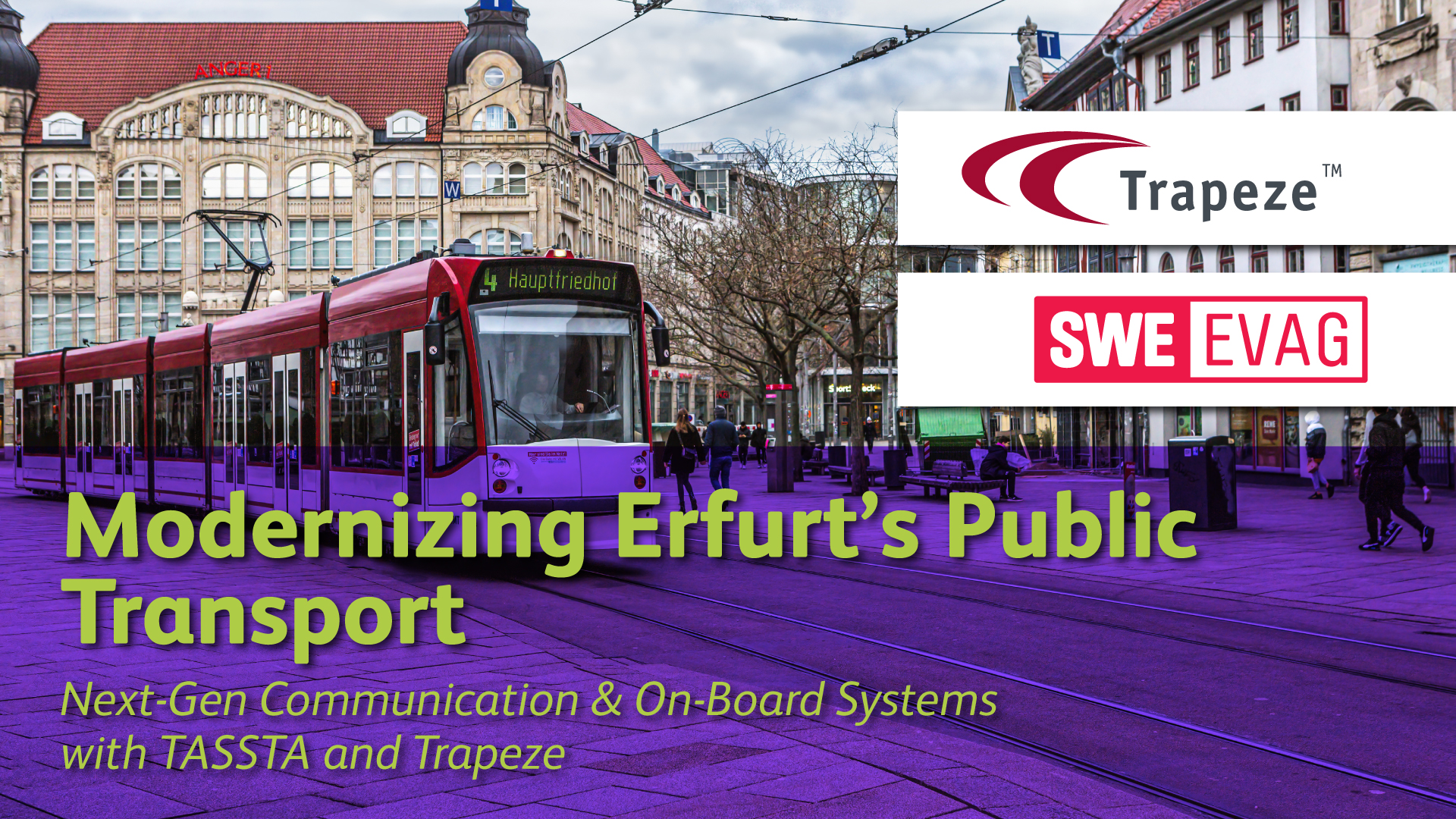
Erfurt’s Public Transport Takes a Big Step Forward with TASSTA and Trapeze
The city of Erfurt is accelerating its journey toward a smarter, more connected public transport system. Erfurter Verkehrsbetriebe AG (EVAG) has teamed up again with TASSTA and Trapeze to modernize its tram fleet’s on-board systems — and the results promise to benefit both operators and passengers alike.
What’s New?
Building on earlier successes, the next phase involves upgrading EVAG’s trams with Trapeze’s state-of-the-art IDR-f3 on-board computers and integrating TASSTA’s advanced voice communication platform. Together, these technologies will deliver faster, more reliable data and communication capabilities — making day-to-day operations smoother and passenger information clearer.
How Does It Work?
At the heart of the upgrade is the IDR-f3 on-board computer, which packs more processing power and includes 5G connectivity. This means the trams can handle more data, faster, and communicate seamlessly even in busy or challenging environments thanks to a hybrid communication system that blends traditional radio with modern mobile networks.
On the voice side, TASSTA’s Push-to-Talk solution replaces EVAG’s older system, enabling instant, secure communication over public mobile networks. Drivers and control centers will use new mobile apps and intercom devices to stay connected easily — a vital upgrade for safety and efficiency.
What Does This Mean for Erfurt?
For passengers, the benefits include real-time departure countdowns displayed outside trams, better tracking of how many people are on board, and more reliable information thanks to integrated data analytics.
For EVAG’s operations team, the combination of smart hardware and communication tools means increased reliability, quicker response times, and the ability to leverage new technologies like AI-powered traffic management in the future.
A Partnership for the Future
This project showcases the strong collaboration between EVAG, TASSTA, and Trapeze. It’s a shared commitment to creating a public transport system that’s ready for the challenges of tomorrow — smarter, safer, and more sustainable.
Looking Ahead
As Erfurt continues to grow and innovate, this modernization effort lays the groundwork for a truly connected city. TASSTA and Trapeze are proud to play a part in helping EVAG deliver better service today — and prepare for the mobility needs of the future.
We’re proud to share that TASSTA has been featured in APAC CIO Outlook, recognized for our innovation in mission-critical communication technology. This feature highlights how our solutions are reshaping the way industries approach secure, reliable, and flexible communication — especially in high-stakes environments where every second counts.
In the article, APAC CIO Outlook dives into the core of TASSTA’s mission: enabling organizations to move beyond the limitations of traditional radio systems with a robust Push-to-Talk over Cellular (PoC) platform. By combining broadband communication with intelligent dispatching, emergency handling, indoor location tracking, and more, TASSTA delivers a complete ecosystem tailored to the evolving needs of industries like public safety, transportation, and energy.
One of the key points made in the piece is how TASSTA bridges the gap between legacy systems and next-gen infrastructure. Our solutions are interoperable, scalable, and can be integrated seamlessly into existing workflows — giving teams the tools they need without forcing a full technology overhaul.
Another important highlight is our commitment to security and reliability. In mission-critical environments, downtime is not an option. That’s why our platform is designed with high availability and encryption at its core, ensuring end-to-end communication remains uninterrupted and protected.
TASSTA Redefines Secure Communication on iOS with T.Star
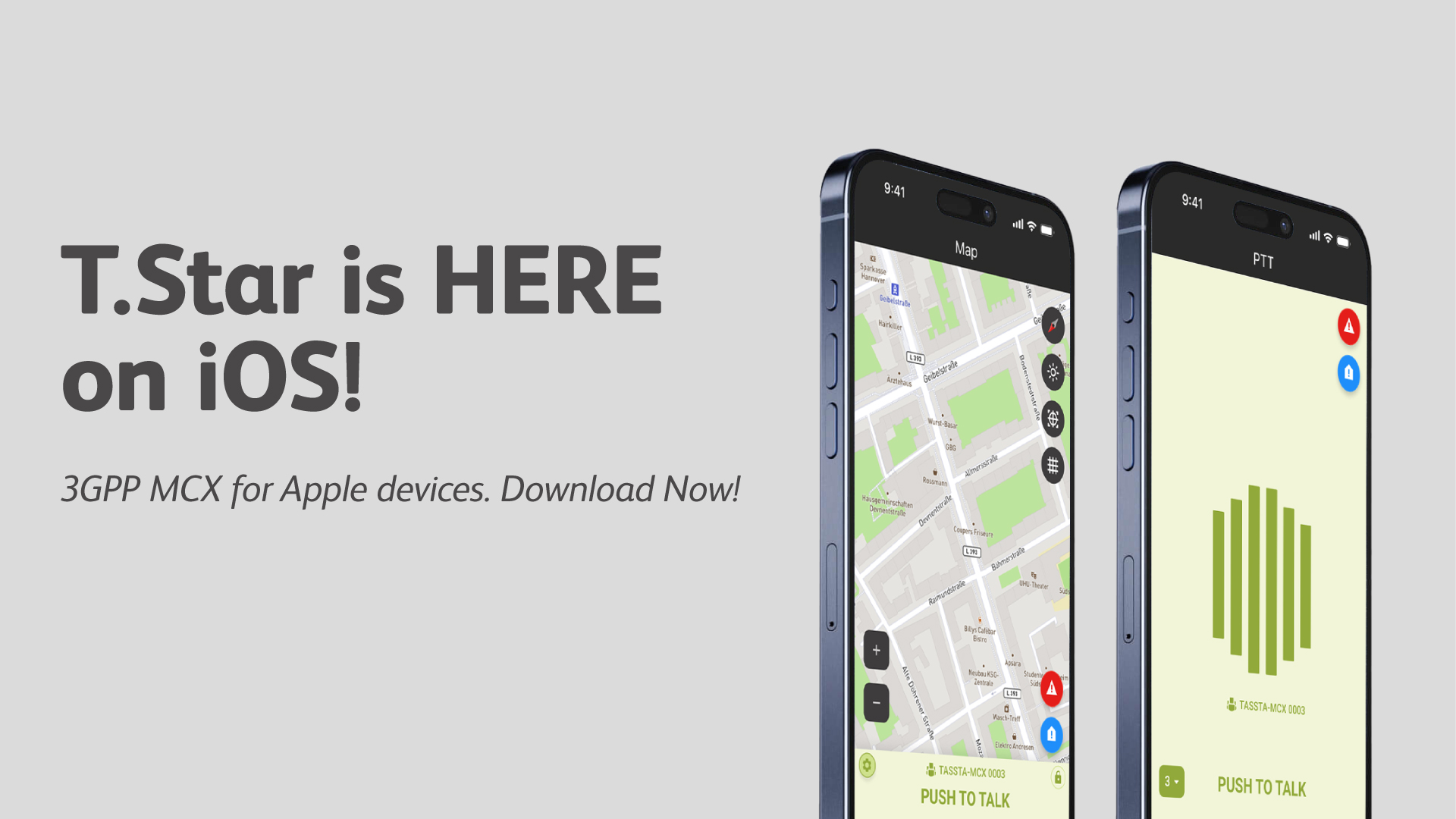
We’re thrilled to announce that T.Star, our cutting-edge 3GPP-compliant Mission-Critical Communication (MCX) client, is now available on the iOS App Store!
For years, the industry has needed a robust, fully compliant mission-critical app for iOS, and we’ve delivered. T.Star is engineered for professionals in highly regulated and strategic environments who demand the utmost in secure, reliable, real-time communication.
T.Star is optimized for LTE and 5G networks, providing the unwavering performance vital for first responders, public safety, emergency services, and critical infrastructure operators.
“This is what the industry has been waiting for, and it will fundamentally redefine how critical operations stay connected,” says Kaveh Hosseinzadeh, General Manager at GMC TASSTA GmbH.
Download T.Star today and experience the future of secure, mission-critical communication on your iPhone:
Game Changer: T.Star Mission-Critical Comms Now Live on iOS App Store!
We’re incredibly excited to share some groundbreaking news: T.Star, our cutting-edge 3GPP-compliant Mission-Critical Communication (MCX) client, is now officially available on the iOS App Store! This is a monumental step for TASSTA and the entire industry, as it makes us one of the very first to bring a fully compliant and robust mission-critical application to Apple’s mobile ecosystem.
Why T.Star is a Breakthrough for Critical Operations
For years, professionals in demanding sectors have yearned for a truly 3GPP-compliant communication application on iOS. While robust solutions have been available on Android, the unique architecture and stringent security requirements of the iOS ecosystem presented a formidable challenge.
As Kaveh Hosseinzadeh, our General Manager at GMC TASSTA GmbH, puts it: “TASSTA is incredibly proud to have overcome this, delivering a truly massive breakthrough with T.Star on the App Store. This is what the industry has been waiting for, and it will fundamentally redefine how critical operations stay connected.”
We’ve engineered T.Star specifically for organizations and specialized professionals who operate in highly regulated, large-scale, and strategic environments. If your team demands the utmost in secure, reliable, and real-time communication – where every second truly counts – T.Star is built for you.
Who Benefits?
T.Star is the ideal communication partner for:
First Responders & Public Safety Agencies
Emergency Services
Critical Infrastructure Operators
Enterprise Teams with the Highest Operational Demands
It provides the robust reliability and peak performance required to manage any scenario with absolute confidence.
Stay ahead with insightful resources. Explore our latest blogs, case studies, and whitepapers that delve into the intricacies of mission-critical communication, technological advancements, and industry trends.